Altbau in Berlin: the capital of the Gründerzeit city
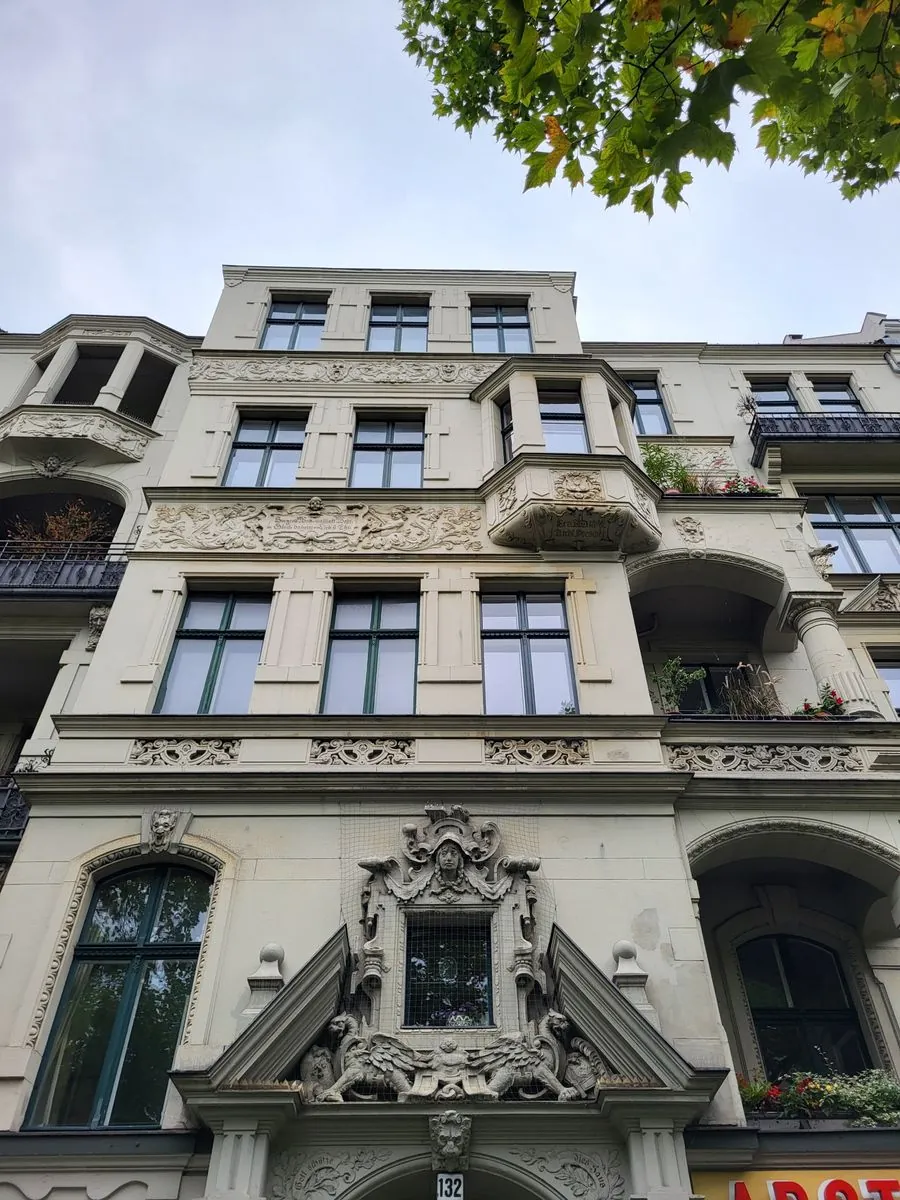
No German city has more Altbau — or a stronger Altbau identity. Roughly 60% of Berlin's housing stock dates from before 1949, and entire districts consist of little else. If you want to understand the German Altbau, you start in Berlin.
Where the Altbau is
The classic Altbau belts wrap around the historic centre: Prenzlauer Berg, Friedrichshain, Kreuzberg, Neukölln, Schöneberg, Charlottenburg, Wedding and Moabit. Each has a character of its own:
- Prenzlauer Berg — the showcase. Restored façades, cobbled streets, the highest density of stucco and the highest rents.
- Kreuzberg & Neukölln — livelier, more mixed stock, many unrenovated back buildings (Hinterhäuser) with raw substance and lower prices.
- Charlottenburg & Schöneberg — the dignified west: generous floor plans, elevators in better buildings, green streets.
- Wedding & Moabit — the frontier: solid stock, often unrenovated, the cheapest entry point inside the ring.
Rents and prices
| District type | Typical rent (renovated) | Purchase, per m² |
|---|---|---|
| Prenzlauer Berg / Mitte fringe | 14–20 €/m² | 6.500–9.500 € |
| Kreuzberg / Schöneberg | 12–17 €/m² | 5.500–8.000 € |
| Neukölln / Friedrichshain | 10–14 €/m² | 4.500–6.500 € |
| Wedding / Moabit (unrenovated) | 8–11 €/m² | 3.500–5.000 € |
Renovated Altbau commands a premium of 30–50% over unrenovated units in the same street — the strongest renovation-value link of any German city. Berlin's regulated rent cap (Mietpreisbremse) applies to re-lettings, but "modernisation" surcharges are a well-trodden loophole.
Renovation specifics
Berlin's scale cuts both ways. Every craft is available, but the best tradespeople are booked months ahead and price accordingly — expect 10–20% over the national average for windows, electrics and stucco work. Two Berlin specifics:
- Stucco is an industry here. Berlin has workshops that re-cast original ornament from surviving pieces; for façades under heritage order this is usually mandatory.
- The Berliner Zimmer problem. Those windowless-ish corner rooms in the middle of large flats are hard to heat and light. Electricians and heating planners quote them separately.
Large parts of Prenzlauer Berg and Spandau Vorstadt are under Ensemble or single-object protection. Window and façade changes need approval — but heritage-accurate work also unlocks better grants. Check the Berlin heritage list before you buy, not after.
Who Berlin suits
Buyers who want maximum choice and are willing to pay for it; tenants who value neighbourhood culture over square metres; renovators who want craftsmen who have seen every Altbau problem twice. Who it doesn't suit: anyone hunting for a bargain — Berlin's discounts were found a decade ago.
Building history and fabric in Berlin
Berlin's Altbau is above all the Mietskaserne: between the founding of the Reich and the First World War the city grew in closed perimeter blocks with a front building, side wing, cross wing and a chain of narrow rear courtyards. Plots were deep and narrow, and flats followed a strict hierarchy — representative rooms facing the street, the famous Berliner Zimmer at the bend into the side wing, smaller and darker rooms towards the courtyards. Anyone renovating today is working with a floor plan designed for a different way of living.
The load-bearing structure is usually brick masonry with timber beam floors; corridors and kitchens often have Prussian cap ceilings, shallow brick vaults spanning between steel beams. Lime plaster, floorboards, tall box-type windows and stucco mouldings are the original fabric worth keeping. Because many buildings survived war damage, division, gutting and several rounds of modernisation, condition is rarely uniform: a single stairwell can contain restored stucco ceilings, suspended plasterboard and walls inserted decades later, side by side.
Renovating in Berlin: authorities, bylaws, grants
Establish the protection status before any work. The Berlin state heritage office lists individual monuments, monument areas and ensembles; many inner-city neighbourhoods also have preservation and milieu-protection bylaws covering floor-plan changes, loft conversions and the conversion of rental flats into owner-occupied units. A brief enquiry at the district office usually settles feasibility faster than a finished building application.
- Survey the fabric first — load-bearing walls, floor build-ups and chimney flues look alike in an Altbau; check the structural records before opening up a wall.
- Account for tenancy law — Berlin has a qualified rent index; modernisation levies, caps and notification duties are tightly regulated.
- Combine funding — federal grants for efficient buildings (KfW/BAFA) for envelope and heating, plus state programmes; always apply before commissioning work.
- Take moisture seriously — vaulted cellars, courtyard walls and plinths often carry salts and damp; vapour-open lime plasters outperform sealed coatings.
Owner associations add one more layer: windows, facade, roof and stairwell are jointly owned, so individual owners cannot set the sequence alone. A staged renovation plan that pairs technically correct ordering with a votable budget — see the renovation budget guide — is usually what actually gets built.
Compare before you commit
Our renovation calculator gives you a realistic first budget for a Berlin Altbau flat — including the city surcharge.
Open the calculatorRent and price figures are researched indicative ranges (October 2026) and vary strongly by street, condition and floor. No paid recommendations.