Restoring timber windows in period buildings: repair before replacement
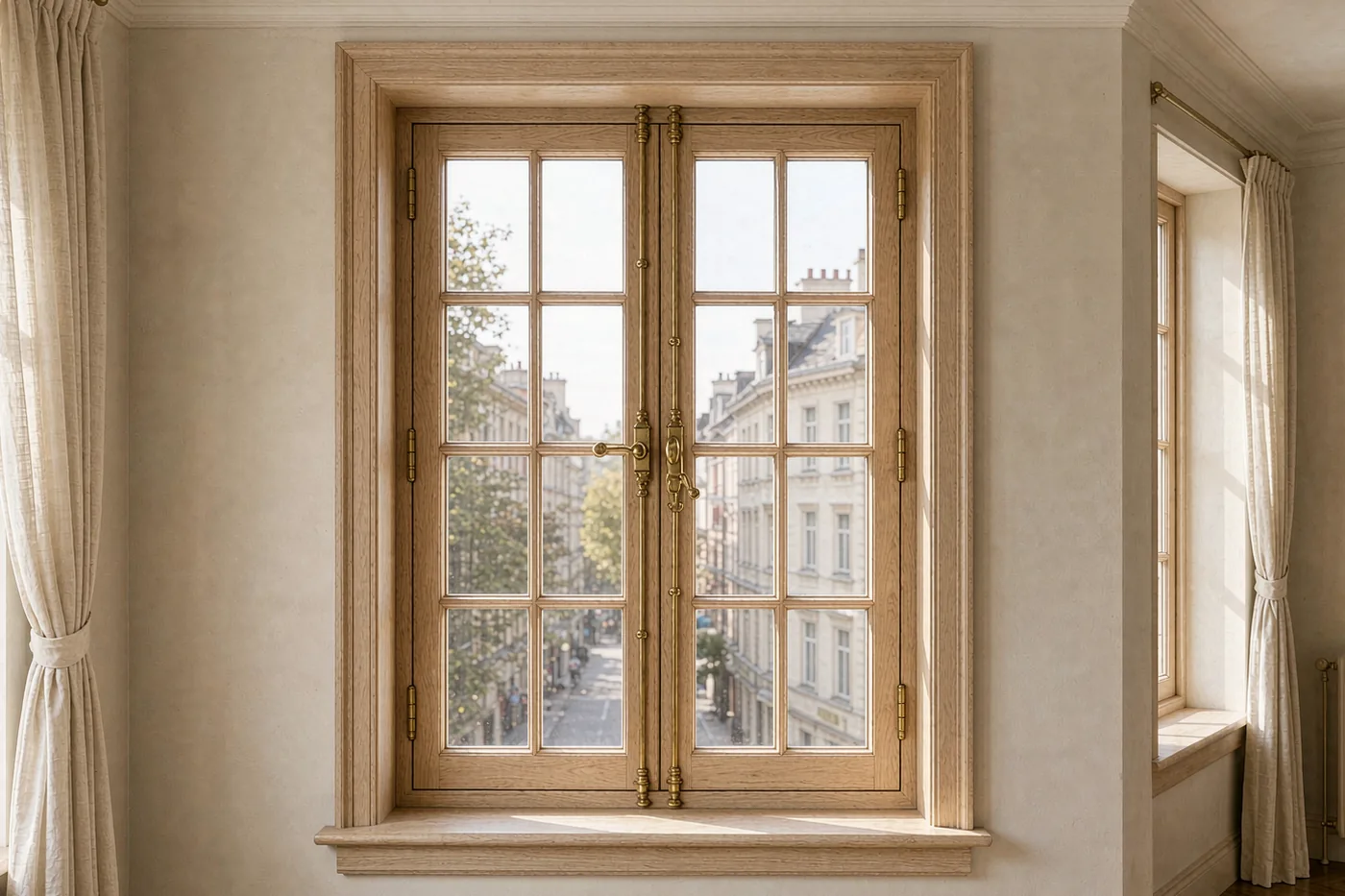
Why old timber windows are worth more than their looks
Timber windows from the late nineteenth or the interwar period were often made from grown timber that is hardly available in the same quality today. They shape the facade, have proportions that suit the house and are long-lasting when properly cared for. The wish for uPVC windows often arises not from the timber itself but from draughts, poor seals or tired paint.
Those symptoms are not an automatic reason to replace. A window that draughts can often be re-sealed; a window with a damp lower edge needs the cause clarified first. When comparing window costs with a full replacement, the repairability of the existing component should be valued too.
The three classic damage patterns
The first pattern is the weathered lower edge of frame or sash: paint flakes, timber softens, rainwater stands. The second is a warped sash that no longer closes — often a consequence of moisture, but also of changed load paths after alterations. The third is poor glazing or sealing, through which draughts and noise enter the room climate.
Three patterns, three answers: weathering calls for moisture protection and perhaps timber replacement, warping calls for a geometry check, and draughts call for a check of seals and hardware. Answering all three with a full window replacement pays for substance that is often still sound.
What moisture does to a window
Moisture collects at the bottom rail because rainwater runs off there and because condensation on the cool pane travels downwards. Repeated over years, the timber loses strength, hardware corrodes and seals lose their seat. Mould on the reveal is then a sign of a room-climate problem, not only a window problem.
Refreshing the paint alone merely moves the problem under the new coating. The useful question is where the water comes from: outside through a defective surround, inside through excessive humidity, or from the masonry. The damp and mould page explains how such sources are distinguished.
Record first, then intervene
Before any work comes a survey: photographs inside and outside, sash dimensions, hardware, glass type, profiles and the type of surround. For protected or especially old windows the record matters because it later serves as a template for repairs. The monument protection page explains why interventions should be clarified in advance.
Then follows the assessment: can the lower edge be repaired? Is the sash warped or simply out of adjustment? Is the hardware adjustable? Only when these questions are answered does it become clear whether part replacement, restoration or, exceptionally, a historically faithful new build makes sense.
Limits of DIY work
Cleaning, adjusting hardware, re-sealing accessible joints and lightly sanding loose paint are tasks that can be done with care. Anyone taking a saw to historic profiles or prising glass out of old putty overestimates the experience needed. Broken glass and destroyed profiles cannot simply be undone.
Installation is demanding too: a new or restored window must be watertight to the outside, airtight to the inside and still able to move. A wrong surround means moisture in the reveal after a short time, regardless of how good the window itself is.
What proper restoration consists of
A durable restoration starts by removing the cause of moisture, continues with repairing or replacing damaged timber sections and ends with hardware, seals and a coating that sheds water while still allowing moisture in the timber to escape. With old timber, an overly tight film is a risk, not progress.
The finish includes measurable checks: does the sash close evenly all round? Does the timber stay dry? Is the junction to the masonry weathertight without sealing the masonry itself? A record with photographs and notes is worth more later than a verbal promise.
Use, tenancy and value retention
In tenancies, window maintenance is often regulated in the contract. Minor care duties may sit with tenants while fabric preservation and replacement rest with the landlord. What matters is that damage to frames and seals is reported in writing before a small defect turns into a damp problem.
For owners, the window stock is part of the building fabric that becomes visible at sale. Well-documented restorations are more credible than a recently installed uPVC frame in an otherwise historic facade. The viewing checklist helps capture the condition systematically.
Cost types rather than prices
This guide deliberately gives no figures. The effort depends on whether only hardware and seals are worked on, whether timber sections must be replaced, whether glazing and putty are renewed and how involved the surround is. What holds up is the structure: survey, cause analysis, timber work, hardware work, glazing, installation, documentation.
Do not compare quotes only by unit price. A quote for full replacement and one for restoration describe different tasks and different service lives of the fabric. What matters is whether the moisture cause appears in the quote at all — not only the new window.
Limits of this guide
Whether a window can be retained, how a profile should be repaired and what applies to installation and insulation is decided by inspection on site and by the responsible authority — not by an article online. Requirements can change; the linked institutions are the starting point for verification.
This is general orientation, not construction, timber-protection or monument advice. There are no paid recommendations and no links to window dealers. What counts are the survey, a written quote and documented execution.
Sources and verification
- dena — German Energy Agency: windows in existing buildings
- DIBt — German Institute for Building Technology (German original)
- Verbraucherzentrale — consumer advice (German original)
These primary sources are starting points for verifying the framework; requirements and deadlines are set by the responsible authority in each case. No paid recommendations.
Frequently asked questions
Is restoration always worthwhile?
Not always, but often. What matters is the condition of the timber, the construction of the sash and whether moisture can be permanently removed. If the fabric is largely intact, restoration is usually more sensible than replacement — also from a monument perspective.
How can I tell whether the timber is still sound?
Press gently at the lower edge with a blunt object: soft, yielding areas suggest moisture damage. Paint alone is misleading. A reliable statement comes from a moisture reading and, if attack is suspected, a professional survey.
Should I oil the hardware myself?
Light care is sensible, but not every type of hardware tolerates oil. Too much dressing attracts dust and can hinder rather than help. If a sash hangs, adjustment matters more than lubrication.
Planning work on an old building?
Windows, wiring, heating, floors — model every line item before you get quotes.
Open the calculatorFor orientation only — requirements depend on the building, the state and the lease. No legal, tax or energy advice. Questions for the editors: hello@altbau.com