Altbau history: how the Gründerzeit apartments came to be
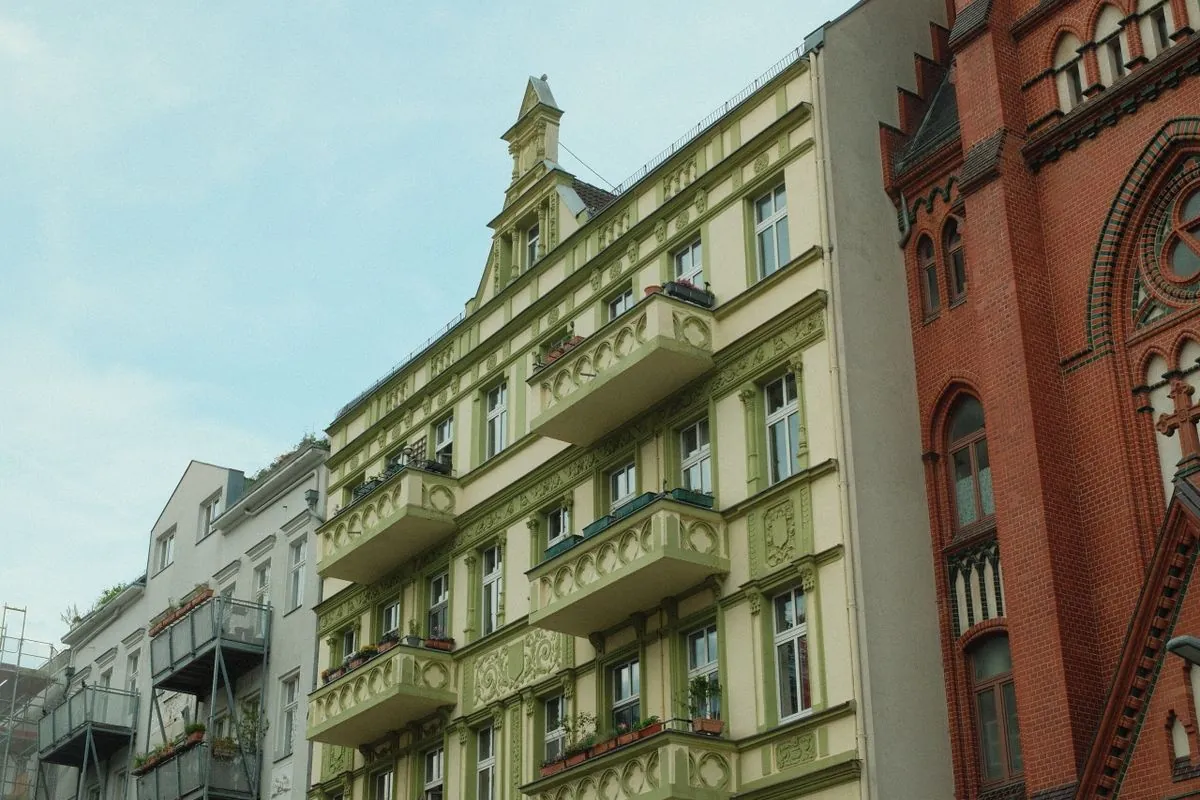
When Germans say Altbau, they mean a building erected before 1949 — but the image in their heads is almost always a specific one: a Wilhelminian-era tenement with high windows, cove ceilings and a stucco facade, built in the few wild decades when the modern German city was born. Understanding where these buildings come from explains almost everything about them — why the walls are so thick, why the ceilings are 3.60 m high, and why renovating one is unlike renovating anything else.
The boom: 1871 and the birth of the modern city
The founding of the German Reich in 1871 unleashed the largest construction wave the country had ever seen. Industrialisation pulled millions into the cities: Berlin grew from roughly 800,000 inhabitants in 1871 to over two million by 1905. Speculators filled whole street grids within a few years — the Gründerzeitviertel in Kreuzberg, Prenzlauer Berg, Wedding, Dresden's Äußere Neustadt, Leipzig's Waldstraßenviertel, Munich's Ludwigsvorstadt.
Most of it was rental housing built for profit — the Mietskaserne (rental barracks): a prestigious street-facing front building (Vorderhaus), wings (Flügel) and rear buildings (Hinterhaus) wrapped around a courtyard, sometimes five or six units deep. The richer you were, the further forward you lived; the poorest lodged in the darkest back courtyards.
Why these buildings are built the way they are
- Massive brick masonry. Exterior walls 40–60 cm thick, load-bearing, plastered inside and out. This is why Altbau walls simply swallow nails — and why they insulate against sound surprisingly well.
- Ceilings of 3.20–4.00 m. Timber beam ceilings span the rooms; height was a status symbol and improved what people then feared most: stale air and disease.
- Box windows and double windows (Kastenfenster). Two window sashes in one frame, often with folding shutters outside — the ancestor of today's soundproofing problem, and its solution (see soundproofing an Altbau).
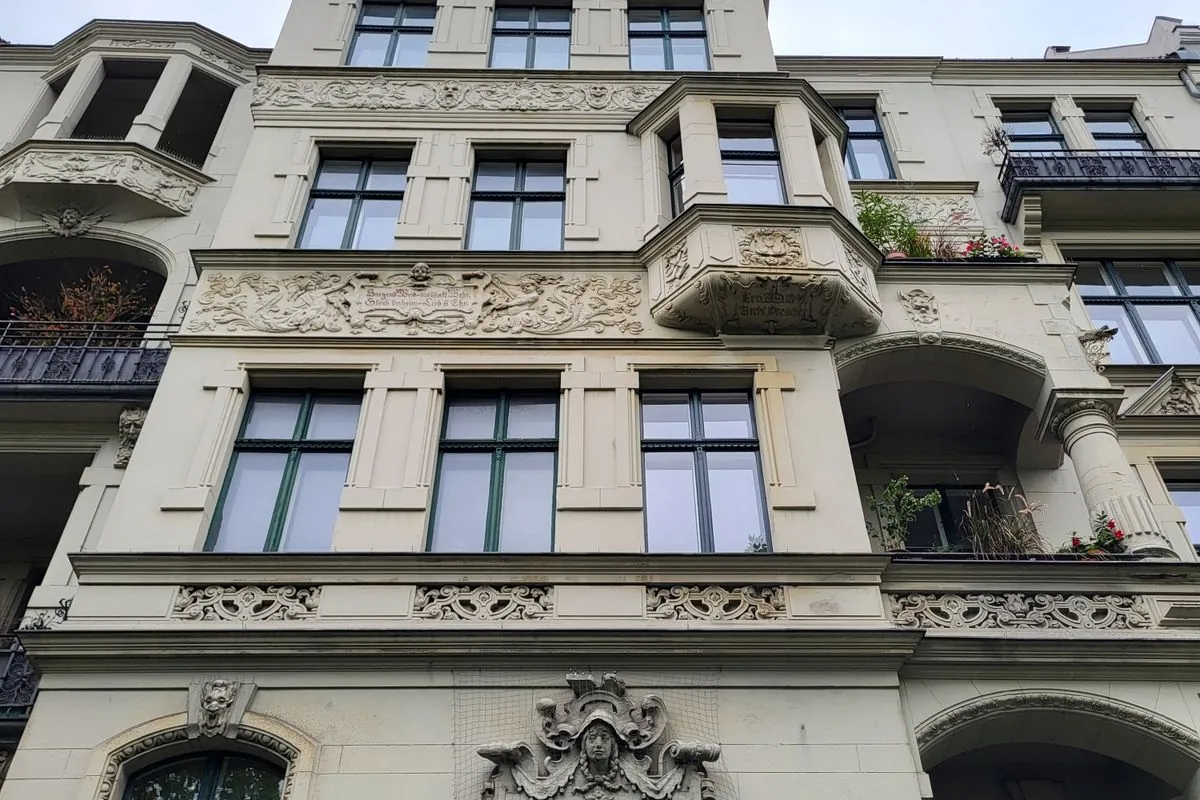
- Stucco everywhere. Machine-made gypsum and cement made ornament affordable — rosettes, coves (Hohlkehlen), door frames. Much of what looks hand-carved was cast (restoring it is its own craft: stucco restoration).
- Wood plank floors, herringbone parquet — often 100+ years old and, after a round of sanding and sealing, better than new.
- Infrastructure arriving late. The first generation had coal stoves, night soil collection and gas light; electricity, bathrooms and central heating only arrived over the following decades — which is why old electrics and heating questions still define Altbau renovations today.
The epochs at a glance
| Epoch | Approx. period | What it looks like |
|---|---|---|
| Vormärz / early classicism | up to 1871 | Plain, solid, generously proportioned — often two-storey palais style |
| Gründerzeit | 1871–1890 | The richest ornament: facades with columns, figures, laurels; 4 m ceilings |
| Wilhelminian era | 1890–1918 | Denser tenement blocks, more restrained facades, first bathrooms |
| 1920s–40s (Neues Bauen) | 1919–1948 | Settlements, flat roofs, function over ornament — often still counted as Altbau |
| Postwar (Neubau) | from 1949 | The line where "old building" officially ends |
The 1949 line is a convention, not a physical one. The housing stocks of, say, Munich or Hamburg blur it happily — but for tenancy law, statistics and this guide, Altbau means: pre-1949.
The dark side of the boom
The same decades that produced the grand facades also produced staggering overcrowding. Around 1900 it was normal for a Berlin flat to sublet beds to night sleepers; courtyards were airless and damp; tuberculosis was called "the Berlin disease". The reform movement answered with garden cities, settlements and building codes — light, air and bathrooms became the demands of the twentieth century. Much of what makes an Altbau "charming" today (the dark rear building, the thin wing wall) was a compromise of its time, and some of what makes it "difficult" (damp cellars, mould risk, noise) has the same root.
War, division and survival
World War II erased large parts of the stock — entire districts in Berlin, Dresden, Hamburg and Cologne were flattened. What survived shaped two very different post-war stories:
- In the East, the tenements stayed, were nationalised, and were patched rather than renovated. By 1990 many were structurally sound but decrepit — which is why Prenzlauer Berg's facades were restored wholesale after reunification, often stripping decades of paint from the stucco.
- In the West, private owners modernised earlier — often replacing windows and heating decades ago. Paradoxically, that means some Western Altbau interiors are less original than Eastern ones.
Both paths ended in the same place: by the 1990s the surviving Altbau was recognised as a scarce asset, and whole quarters were placed under preservation orders (Erhaltungssatzung) or heritage protection. Facades may be repaired, but the street image is frozen — one reason Altbau floor space now trades at a premium over new builds in most big cities (see the market radar).
The building's decade is a preview of your cost list. Gründerzeit usually means 4-metre ceilings, box windows and (possibly) knob-and-tube wiring; Wilhelminian often means first-generation bathrooms and single glazing; 1920s can mean flat roofs and early central heating. Our renovation calculator lets you model windows, electrics, heating and interiors line by line — and the grandfathering rules decide what you may change without triggering the modern building code.
Why people still love them
Ninety-centimetre walls keep summer heat out and street noise low. Timber floors breathe; ceilings make even small rooms feel grand. And unlike almost any modern build, the flat has a story — factory owner's salon by night, sublet room by 1905, shared flat by 1978, family by 2020. The Altbau is the only housing type Germany has that is simultaneously a commodity, a monument and a culture. That is what you are buying or renting when you move into one — and what a renovation, done right, protects rather than erases.
Planning work on an old building?
Windows, wiring, heating, floors — model every line item before you get quotes.
Open the calculatorHistorical overview for orientation — period attributions vary by city and source. Questions for the editors: hello@altbau.com