Moving into a period apartment: what to settle before signing the removal quote
Why the quote comes last
A removal quote is only as reliable as the information behind it. In a modern building with a lift opening onto the flat, effort can be estimated roughly from volume and distance. In a Gründerzeit building, something else often decides both the price and whether a piece of furniture arrives at all: the route. Narrow stairwells, several rear courtyards, no place to stop outside and a small lift retrofitted decades later are not automatically included in any standard calculation.
Discovering on moving day that the sofa will not turn at the half-landing leaves a problem that money on the spot cannot fix. That is why the survey of the transport route belongs before the request for a quote — not in the contractor's follow-up question two days earlier. It is also a natural extension of the viewing checklist: that one covers the fabric, this one covers logistics, at the same address.
From the pavement to the front door: the carrying route
The first leg lies outside the flat. In dense period districts the street is often fully parked, loading bays are missing, and a van either stops too far away or blocks an entrance. Whether a temporary no-parking zone is needed depends on street width, traffic and local rules; it is applied for at the responsible road-traffic authority or district office, not with the landlord. Who puts up the signs, and where the van may actually stand, also need settling in good time.
The second leg crosses the plot. Berlin tenements typically have a front building, side wings and one or more cross wings, so the flat may sit behind two or three courtyards. Every passage has its own width, ramps or steps, and sometimes a gateway with limited headroom. The value that matters is not the distance on a map but the real carrying route from loading point to building entrance — including every step, door and pinch point.
Time windows come on top. Some house rules restrict removals to certain hours or require the lift to be booked and the hallway covered. In a condominium the property manager is the right contact; in a tenancy it is the landlord or managing agent. A quote that assumes a free parking space right outside is not a quote, it is an assumption.
The stairwell and the half-landing turn
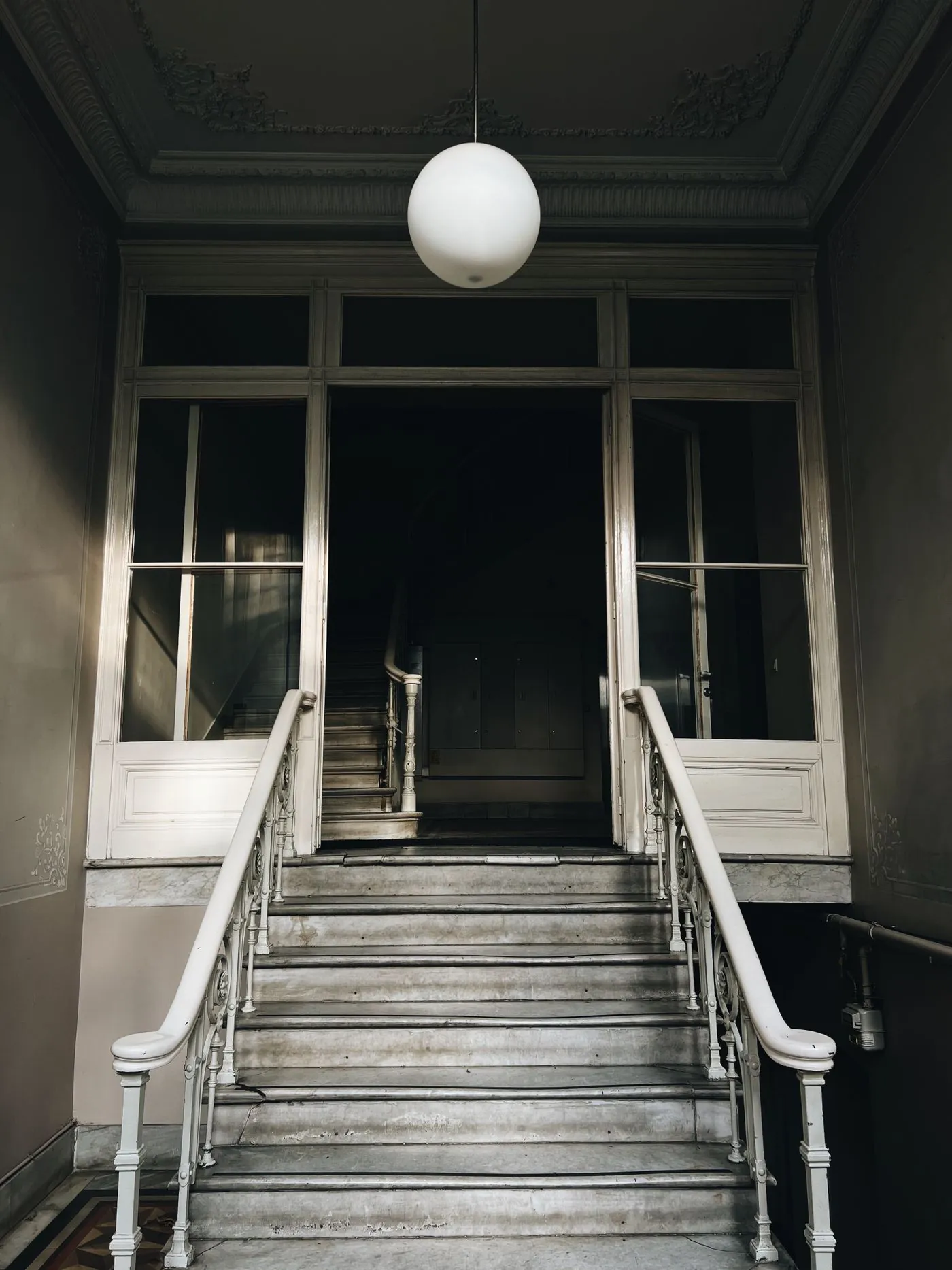
Gründerzeit stairwells were built to impress, not to carry bulky goods. Narrow flights, tall risers and a counter-turn at the half-landing between floors are characteristic. That is exactly where a long, rigid item jams — not because it is too heavy, but because the geometry leaves no room to rotate. What matters is the clear width of the flight, the depth of the landing, the height of the balustrade and whether a handrail or plasterwork projects into the swing area.
Measure the narrowest point and look at the largest single item, not the total number of boxes. A wardrobe, a sofa with a continuous back panel or a long dining table can often be dismantled; a solid antique cabinet or a piano cannot. Photos help little without a scale — a short video walking the flight, with a tape measure held open at the landing and door, tells the contractor more than ten pictures of the living room.
Where the fabric is protected, monument protection adds a layer: balustrades, plasterwork, doors and wall surfaces must not be used as leverage or support, and protective coverings have to be agreed before the first item is moved. A scratch in a historic stairwell is not trivial damage but a dispute with the owners and possibly with the monument authority.
Lift, door widths and the largest item
Many lifts in period buildings were retrofitted decades later. The cabin is narrow, the opening tight, the load limit modest, and the lift may stop at the half-landing rather than the floor. The figures to record are clear door width, clear door height, cabin depth and the height of the approach from the landing — not the door dimensions in a manufacturer's brochure.
Just as often forgotten are the flat's own door, the hall behind it and narrow doorways between rooms. An item can pass the lift and still fail at the last door. Recording the dimensions once makes them reusable for the quote request, for furniture planning and later for tradespeople's deliveries; the glossary covers the technical terms if the contractor asks about clear dimensions or carrying routes.
If it is clear that something will not fit through the stairwell, the alternative belongs in the quote: an external furniture lift, dismantling and reassembly, or a different route. These options change the effort fundamentally and should be named before signing, not as a surprise line on moving day.
What the removal company needs before it can calculate
A useful enquiry contains more than floor level and floor area: which storey and whether there is a lift, the number of courtyards, the carrying distance from the loading point, the parking situation outside, dimensions at the tightest point in the stairwell, lift-door dimensions, a list of bulky items and whether anything must be dismantled. Add any wishes for assembly, packing material, storage or a fixed time slot.
Equally important is asking what the quote actually includes: carrying distance, floor surcharges, waiting time, permits for a no-parking zone, insurance and liability for damage to the stairwell, dismantling, disposal of packaging. Two quotes only become comparable once these line items match. The measure matrix on this site uses exactly the same logic — separate the cost type and the trigger before comparing figures.
Cost types rather than prices
This guide deliberately gives no amounts. They depend on region, season, volume, carrying distance, access and negotiation, and they age faster than any other figure in a building. The reliable part is the structure: volume and weight, pure driving time, labour for long carries, surcharges for a missing lift or a difficult turn, permits, assembly work, materials, insurance and any interim storage.
When checking a quote, you should be able to ask which assumption sits behind each line. An unusually low price is often not a cheap contractor but a quote that never counted the third courtyard, the half-landing or the no-parking zone. Extras appear precisely at the points nobody wrote down beforehand.
House rules, neighbours and the day itself
Before the move, read the house rules and put a short notice in the stairwell: time window, lift booking, protection of floors and handrails, waste and packaging, key handover and who to contact about damage. With listed fabric or in a condominium, written consent from the property manager is sensible before moving furniture across sensitive surfaces.
On the day, a simple sequence helps: clear and protect the route first, re-check the dimensions at the pinch point, then move the large items, then the boxes. A photograph of the stairwell before starting is no substitute for insurance, but it saves a lot of argument if something is disputed. And if an item does not fit, stopping is almost always cheaper than forcing it.
Limits of this guide
Which no-parking zone is approved, what conditions the road-traffic authority imposes and which liability applies in a specific case are decided by the responsible body or by the contract with the removal company — not by a guide on the internet. Dimensions also vary from building to building, even within the same building history and the same block.
This is general orientation, not legal, insurance or transport advice. It contains no paid recommendations and links to no providers; for a real decision, an on-site survey, the property manager and a written quote with itemised lines are what count.
Sources and verification
- German Road Traffic Regulations (StVO) — stopping and parking rules
- Berlin.de — district offices and temporary no-parking zones
- Verbraucherzentrale — moving and removal companies
These primary sources are starting points for verifying the framework; permits and conditions are set by the responsible authority in each case. No paid recommendations.
Frequently asked questions
Does every period-building move need a temporary no-parking zone?
No. It is needed when the van otherwise has no lawful, sufficiently close place to stand. Street width, traffic and local rules decide; the road-traffic authority or district office is responsible, not the landlord.
Is saying 'third floor, lift available' enough for a quote?
Rarely for a reliable one. Clear lift-door width, whether the lift stops at the floor or the half-landing, the number of courtyards, the real carrying distance and dimensions at the tightest point of the stairwell matter just as much.
Who is liable for damage in the stairwell?
That is set by the contract with the removal company and by insurance; with listed fabric, additional conditions from the property manager or the monument authority may apply. Document the condition beforehand and settle liability in writing.
Planning work on an old building?
Windows, wiring, heating, floors — model every line item before you get quotes.
Open the calculatorFor orientation only — requirements depend on the building, the state and the lease. No legal, tax or energy advice. Questions for the editors: hello@altbau.com