Altbau in Innsbruck: alpine walls and alpine prices
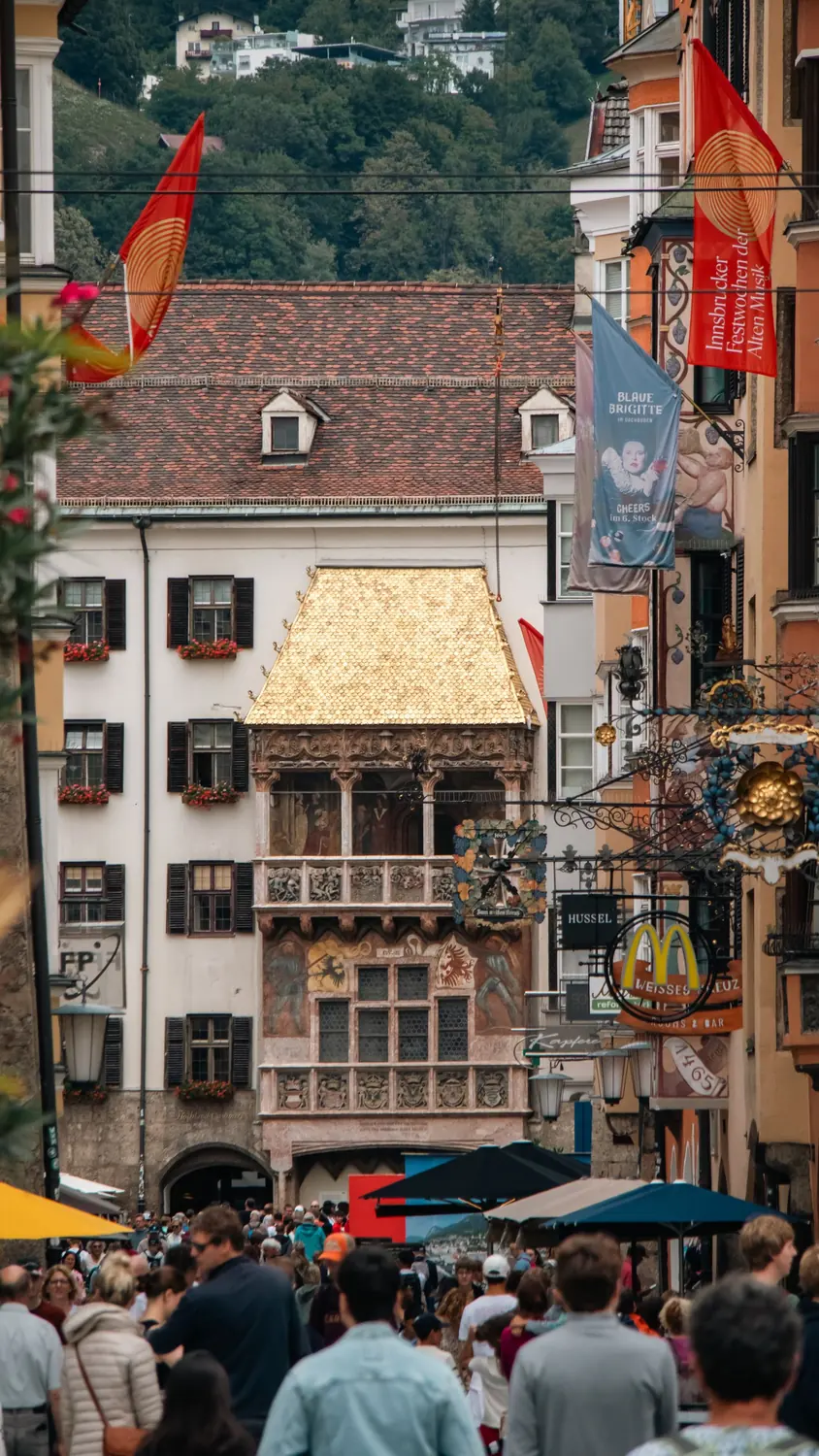
Innsbruck is Tyrol's capital, roughly 135,000 people wedged between the Nordkette ridge and the Inn — a city you can walk across in forty minutes, with a ski jump on the skyline. That geography is also the market's core problem: the valley floor is built out. Green belts and avalanche zones cap expansion, the winter tourism economy keeps demand high, and second homes soak up supply. The result is striking: despite its size, Innsbruck ranks among Austria's most expensive cities per square metre, with rents rivalling Vienna's best districts.
Where the Altbau is
- Altstadt & Dreiheiligen — the historic lanes around the Goldenes Dachl and east toward Dreiheiligen: small stock, postcard setting, the city's most sought-after and most expensive Altbau.
- Wilten — the old western suburb: the monastery quarter, lively, mixed stock from Baroque cores to Gründerzeit, popular with students and young buyers.
- Pradl — the workers' Gründerzeit quarter across the river: the cheapest Altbau in town, solid blocks, steady improvement.
- Saggen — the elegant belt: bourgeois houses and villas on the quiet side of the Inn, Innsbruck's most prestigious addresses.
Rents and prices
| Area | Typical rent (renovated) | Purchase, per m² |
|---|---|---|
| Saggen | roughly 17–22 €/m² | roughly 8.500–12.000 € |
| Altstadt / Dreiheiligen | roughly 16–21 €/m² | roughly 8.000–11.000 € |
| Wilten | roughly 14–18 €/m² | roughly 6.500–9.500 € |
| Pradl | roughly 13–17 €/m² | roughly 5.500–8.000 € |
Indicative ranges only — scarcity, tourism and second-home demand keep Innsbruck's levels among Austria's highest despite the city's size.
Renovation specifics
- The mountain climate is a stress test. Heavy snow loads on roofs and balconies, driving rain on exposed façades, hard freeze–thaw cycles: roof structure, drainage and window connections must be built for it, not just insulated for winter.
- Façade moisture management is decisive. Weather-side walls take a beating; correct plaster systems, functioning roof overhangs and sealed window reveals matter more here than almost anywhere in Austria. Know the damp and mould basics before you view.
- View axes and ensembles are protected. Sight lines to the Nordkette and protected old-town ensembles restrict façade changes, roof extensions and colours; Tyrol's funding programmes can offset approved renovation costs. Check restrictions before buying, not after.
When a city cannot grow, every flat is a trophy. Innsbruck buyers routinely compete with cash-rich second-home purchasers — decide early whether you are buying a home or bidding in a beauty contest, and set your ceiling before the viewing. The viewing checklist keeps you disciplined.
Who Innsbruck suits
Buyers whose life is the mountains — winter sports, climbing, the university or Tyrol's administration economy — and who accept alpine prices as the entry fee. Investors with long horizons: scarcity plus a university plus tourism make vacancy nearly impossible. Who it doesn't suit: value hunters and anyone needing big-city amenities — you pay Vienna's best-district prices for a city of 135,000, and the nearest metropolis is Munich.
Compare with our other city guides, including Vienna and our Linz guide, and plan line by line in our renovation budget guide.
Building history and fabric in Innsbruck
Innsbruck's Altbau joins alpine building tradition with the Gründerzeit of a regional capital. The old town is defined by arcaded passages, Gothic and Baroque townhouses, thick walls and steep roofs; in Saggen, Wilten, Pradl and along the Innrain, villas and apartment houses appeared in the nineteenth and early twentieth centuries with stucco facades, bay windows, balconies and generous stairwells. The mountains are more than a backdrop: they determine climate, orientation and roof construction.
The fabric ranges from rubble-stone and brick masonry with lime plaster through timber beam floors to the heavy, snow-load-ready roof frames of older houses. Heavy precipitation, freeze-thaw cycles and the confined valley make facades, roof drainage and plinths the critical points. The old town adds protected ensembles, irregular floor plans and shared party walls that turn every intervention into a neighbouring issue too.
Renovating in Innsbruck: climate, heritage, snow load
The Federal Monuments Authority and Tyrolean state and municipal rules should be involved early wherever historic fabric is present; roof work brings snow load, insulation and ventilation together. Energy renovation here has to reckon with an alpine climate in which poorly executed internal insulation quickly leads to condensation and mould.
- Roof and drainage — check gutters, downpipes, snow guards and covering before any insulation work.
- Let the facade breathe — lime plasters and vapour-open coatings rather than sealed systems under high rainfall.
- Calculate internal insulation — dew point, reveals and radiator niches need careful detailing where facades are protected.
- Coordinate funding — bundle Tyrol state support, federal programmes and heritage conditions before applying.
With Innsbruck's Altbau, the envelope is the most important investment. A dry roof, sound joints and functioning drainage protect historic fabric more reliably than any later technical retrofit — and preserve the cityscape, which lives off the proportions of its roofs.
Budget for an Innsbruck renovation
Tick "high-cost region" in the calculator to reflect Tyrol's trade prices, or plan in detail with our renovation budget guide.
Open the calculatorRent and price figures are researched indicative ranges (November 2026) and vary strongly by street, condition and floor. No paid recommendations.